DispatcherSync is a platform for a truck driver and the dispatcher they work with to share documents, loads and notices without calling each other twenty times a day. It is built around an uncomfortable idea: the less the software decides for you, the better.
A dispatcher is the person who looks for loads for one or several trucks and coordinates pickups and deliveries. The work largely consists of moving paper —rate confirmations, delivery notes, proof of delivery, scale tickets— and repeating over the phone data that is already written somewhere. That is where hours are lost and errors appear.
What it does
The driver scans with the camera. The capture is multi‑page, detects document edges, corrects perspective, warns if focus is off and lets you retake the page that came out wrong. Then the system classifies the scanned material: rate confirmation, delivery note, proof of delivery, receipt of lumper, fuel invoice, scale ticket or “unidentified”, which is also an honest response.
From that it extracts the fields and proposes them with its confidence level, indicating on the image where each came from. Everything is organized by load, type, driver, dispatcher and date.
The chain of legs —where you are, where you pick up, where you deliver and where you pick up again— feeds an estimate of distance and arrival time, and alerts on three things: missing data, an appointment at risk, and the earliest possible arrival time.
Who sees what
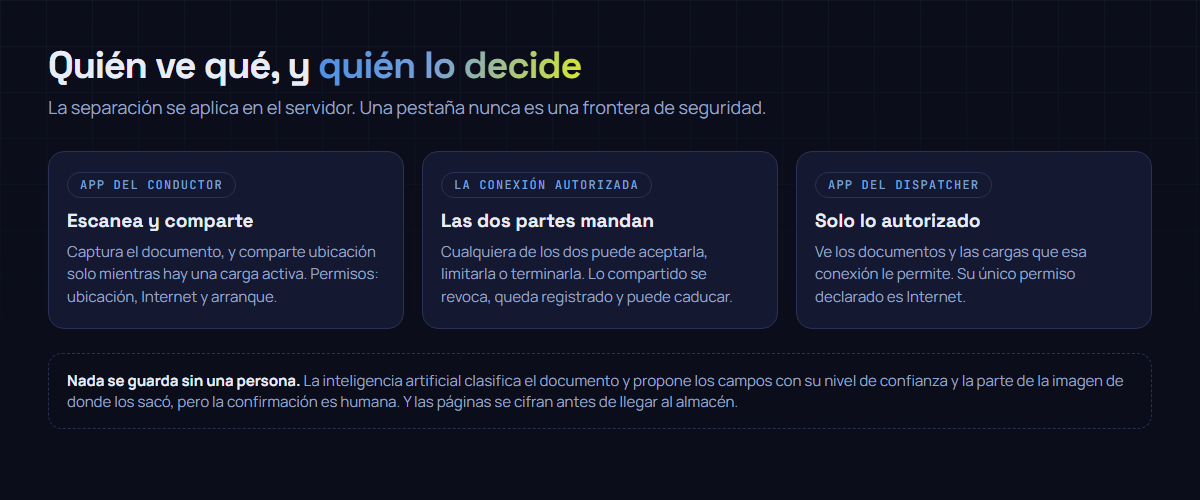
Each person has their own account. For a driver and a dispatcher to share something there must be an authorized connection between them, which both parties can accept, limit or terminate. Everything that is shared is granular, revocable, auditable and can expire.
Separation is not done by painting different tabs. It is applied on the server by organization, by connection, by load and by permission. The phrase that sums it up is written in the product documentation: a visual tab is never considered a security boundary.
What it deliberately does not do
- No navigates. Neither turn‑by‑turn directions nor a promise of a legal truck route.
- Does not replace the ELD nor certify service hours.
- Does not assign, book, accept or negotiate loads for the user, and does not control schedules, routes, rates or exclusivity. That is what keeps White Hat out of the employer or broker position.
- Does not publish reputation or accusations about brokers, carriers or facilities. The history of relationships and previous visits is private to each user.
- Does not train models with the client’s documents.